
Researcher Syntheses
This page features synthetic secondary research of interest to researchers on language learner autonomy or related topics:
- A Qualitative Synthesis of Practitioner Research of English Language Learner Autonomy in Higher Education in Japan
- Synthesisability and optimising exploratory action research for continuing professional development
- A protocol for a qualitative synthesis of practitioner research of language learner autonomy in Japan
A Qualitative Synthesis of Practitioner Research of English Language Learner Autonomy in Higher Education in Japan
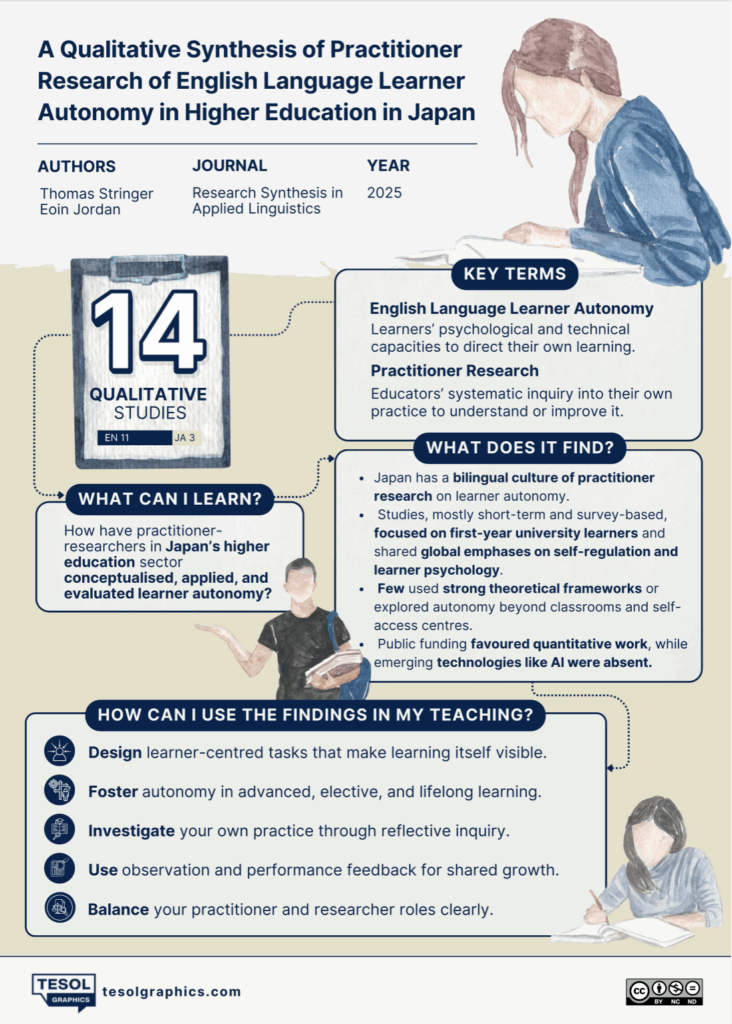
Stringer, T., & Jordan, E. (2025). A Qualitative Synthesis of Practitioner Research of English Language Learner Autonomy in Higher Education in Japan. Research Synthesis in Applied Linguistics, 1–45. https://doi.org/10.1080/29984475.2025.2584790
This study draws on Chong and Reinders’ (2025) international scoping review to offer a nationally focused, qualitative synthesis of bilingual practitioner research on the conceptualisation, operationalisation, and evaluation of English language learner (ELL) autonomy in Japan. The scarcity of chances to use English, alongside a facilitative domestic publishing culture, have made autonomy a key practitioner research focus. However, this work has not undergone systematic secondary review. As such, while aiming to benefit Japanese audiences, the study also hopes to broaden international access to research published in Japanese. Adopting systematic procedures aligned with the Synthesis Methods and Reporting Tool (SMART) for Research Syntheses in Applied Linguistics (Chong, 2025), data from 14 studies was extracted, inductively coded, and discursively analysed following a literature search on CiNii, a Japanese research database. The findings revealed points of convergence (e.g., conceptual prevalence ordering) and divergence (e.g., use of non- experimental research designs, focus on the transition to higher education) between domestic and international settings. Practitioner-researchers are recommended to adopt diverse research designs using performance-based measures, ground work
Research Article: Synthesisability and optimising exploratory action research for continuing professional development
Continuing Professional Development through Action Research has long been linked to Teacher Autonomy ( i.e., Kennedy, 2005). This new Open Access article by Thomas Stringer explores a new idea of research quality – ‘synthesisability’. How can teachers grow their practice through Exploratory Action Research AND ready their work for inclusion in a research synthesis (study combining research findings)?
Cite this article:
Stringer, T. (2024). Synthesisability and optimising exploratory action research for continuing professional development. Educational Action Research, 1–18. https://doi.org/10.1080/09650792.2024.2362706
Research Protocol: A protocol for a qualitative synthesis of practitioner research of language learner autonomy in Japan
This qualitative synthesis of research will focus on practitioner research of language learner autonomy published in either English or Japanese language, with a view to understanding its conceptualisation, operationalisation, and evaluation.
Cite this protocol:
Stringer, T., & Jordan, E. (2023). A protocol for a qualitative synthesis of practitioner research of language learner autonomy in Japan. (IDESR000105 ed.) (pp. 1-8). International Database of Education Systematic Reviews. https://idesr.org/article/IDESR000105
Suggest a synthesis
Your message has been sent
